Saturday, June 5, 2010

Evolve

I'm not saying that all believers in a religion don't believe in evolution, though, but I don't find it strange that people who reject the idea of evolution are the ones who do not evolve.

Surely, evolution doesn't work that way. Everyone and everything is subject to change, good or bad. Evolutionists and people who accept the fact that the theory of evolution is a possible explanation for the origin of life are open to the change. They are liberal and open to most, if not all, ideas. People who reject evolution wholeheartedly, on the other hand, have a deep-rooted conservative sense.

This overly conservative mindset is what hinders them to accept change, to accept new ideas and methods. They prefer doing things in an old-fashioned obsolete way. There isn't a problem with just that but fixation in old methods will lead to refusal to accept change, which in turn would lead to hindering of the human's evolutionary process.

It's not wrong to use old ways in the present time but in this ever-changing universe, we would have to cope up with the changes and sometimes, we would have to discard the old methods entirely and embrace the new. That is what it means to evolve.

Evolution isn't entirely progress with purely positive results; it is more of a trade-off. Amphibians traded off their gills for lungs. Creatures living in the dark traded off their eyes to utilize their other senses. In the same way, humans will have to discard one thing, whatever it may be, in favor of another.

Liberal humans evolve. Conservative humans do not. Evolution occurs only to those who acknowledge it. Halting this natural process would be for the worse.

Tuesday, April 13, 2010

Subjective Heaven

Assuming that Heaven can be experienced fully by the five senses and isn't just some elated level of "existence", it must be a state of absolute contentment and happiness. Many describe heaven as a place of eternal and absolute beauty but that wouldn't seem to be the case anymore - the ever-so-unfalsifiable Bible being retconned several times.

Given that addiction to chocolate isn't a sin, a Heaven-bound person who's addicted to chocolate would experience Heaven as a place filled with his vice. But since not everyone likes chocolate, there wouldn't be a single objective experience of this so-called Heaven. Other heavens would include whatever the Heaven-bound person likes.

But here's an extreme example. Suppose there is a Believer Girl A and an Atheist Guy B who love each other despite their beliefs. When they died, the Guy is sent to hell while the Girl, to Heaven. The Girl's innermost desire is to be with the Guy for eternity. What kind of Heaven will the Girl experience?

Would the god bend the rules for the girl so she can be with her lover? That would be unfair for everyone else. Would the Girl be ineligible to go to Heaven for loving an Atheist? That would be petty. Would the god create an illusion of the Guy that the Girl will love? That'd be cruel. Will the god strip the soul of its senses so that it can only experience unconditional bliss? That'd be even worse.

Here's the easiest way to get to "Heaven". Take Acid.

Friday, March 26, 2010

Suffering Honesty

A child breaks his mother's vase. The mother tells the child to become honest and asks the child. The child admits to his fault. The mother scolds the child. The child gets scarred for life.

This is a typical scenario in almost every household - no doubts about that. But as the child grows up, the negative reinforcement had already made a mark in his mind that honesty would yield bad outcomes. As a result, the child lies to escape punishment.

In the world today, there is no such thing as an "honest politician". People have to lie to get on with their lives because of this. Honesty doesn't yield anything other than suffering. An honest person is always the martyr.

Friday, March 5, 2010

Chaotic Universe

Theists usually say that explosions do not create order, referring to the Big Bang theory. Atheists counter the statement by stating an example of an explosion that creates order. But before anything else, what is order? What is chaos?

Say a child was brought up in an environment filled with love and care; he will perceive the world as a harmonious one with positive aspects. As for a child brought up using violence and punishment, his way of living would revolve around violence and punishment. He will perceive any violent act as a natural thing to do.

Humans are born in this universe and assimilated themselves into it, seeing beauty in its asymmetry. But is this really "order"? What kind of order is this, anyway? Total order would only be total absence of existence, which isn't the case of this universe. There is too much variation and conflict. Humans are no different from molds growing on stale bread; the molds grow and thrive on something that can exist peacefully without it.

What if this is actually "chaos"? No. This universe is indeed chaotic. Humans are chaotic beings living in a chaotic universe, thus their senses have been accustomed to this chaos and interpret it as "order". Mix in some awareness and you'll get conceit that this order is specifically made for them.

Some people think that the night sky is beautiful. Some see beauty in the rings of Saturn. Some, in death, blood, and gore. But looking at it from an extraterrestrial perspective - no, an extra-universal perspective, everything in this universe would seem pretty ugly. Humans just pick out what they think is orderly and beautiful according to their preference. That alone makes the definition of "order" pretty vague and ironically, pretty chaotic.

The theists are right for once. Explosions, indeed, do not create order.

Friday, February 12, 2010

Analysis: A Christmas Carol

In the story "A Christmas Carol" by Charles Dickens, the main character Ebenezer Scrooge had been shown three different scenarios of the past, present, and yet to come. Each scenario was shown with the hope of making Scrooge change from his selfish ways, with the last scenario finally succeeding.

The last scene seemed rather off though. Scrooge only yielded to the possible future that he might be buried in an unattended grave. He then changed after that into a generous person.

Why is this though? From my point of view, he changed only to save his own skin and prevent the possible view from happening. In the end, his acts of selflessness can have a reason other than just "wanting to change". In a way, this is a form of "selfish selflessness" and not "absolute selflessness" at all. In the end, one really can't say that Scrooge has fully converted since he converted only out of convenience rather than realizing any wrong in his actions by himself.

This makes the story a weak basis of morals. Rooting good deeds out of threats is negative reinforcement.

Then again, things like these are unavoidable.

Monday, January 18, 2010

Prayer is Evil

The term "evil" has been redefined over ages past. The very first definition of "evil" we encounter is an action or some sentient entity which inflicts harm on another entity (regardless of sentience) or basically something downright immoral. The concept of morality itself is pretty vague because of the issue of subjectivity, hence "evil" is redefined.

The evil of lying and murder can be justified by the reason they are committed, as the concepts of "white lies" and "eye for an eye" stand. Committing such atrocities for no reason other than promoting the life of others is then considered evil. Hence, evil is defined as an act that benefits the minority while oppressing the majority.

By the definition of Christians themselves, selfishness is evil. *

The act of prayer is rather questionable. It is the act of wishful thinking and meditation. A person would usually pray for others to create a good image for himself, showing others that he is doing something when he is actually doing virtually nothing at all. Instead of acting on the problem as directly as possible, the person merely sits down, puts his hands together, and thinks a lot while muttering, giving himself the impression that he is "helping".

What does one get from prayer? A hollow sense of self-satisfaction. What do others get? Nothing. They don't even receive any telepathic consolations or whatsoever. Moreover, these people suffer while the praying people already feel satisfied. This is better defined by the words "hypocrisy" and "slacktivism". What can we conclude from all this? Read the title.

* Disclaimer: I don't subscribe to this belief. I subscribe to this one.

Saturday, January 16, 2010

Infinity Paradox

Imagine a circle, for example. Say the circle's circumference is 2m. Take a 2m arc from it and you'll get the whole circle. Now take another circle with a 4m circumference; a 2m arc would be half of its circumference. With 8m, a 2m arc would be a fourth, and so on...


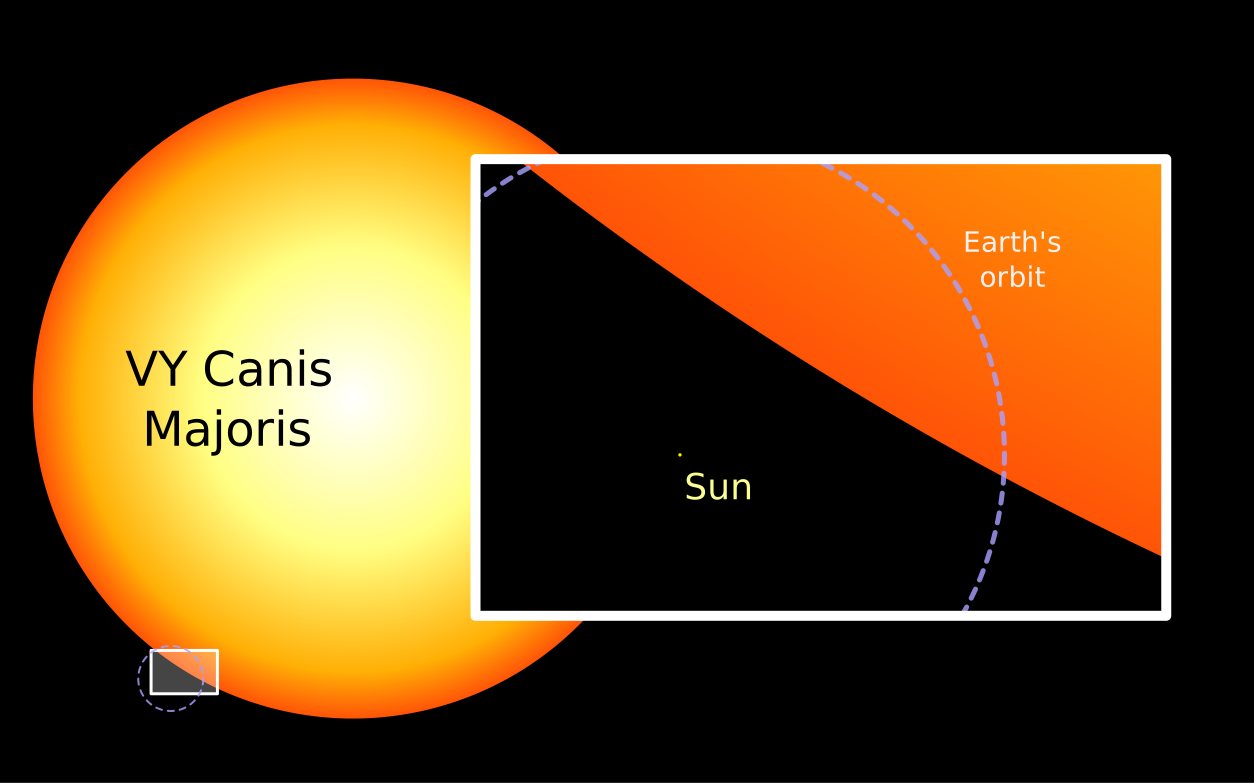
As we can see, as the size of the circle increases, a 2m arc from the circle loses its curvature, approaching the image of a straight line. If we put the earth beside the sun, it would appear that the sun has a flat surface, more so if we put the earth beside VY Canis Majoris, the largest star known as of now.

Let's now think of what would happen if the circle is of "infinite" size. What would the 2m arc look like? A straight line? Logically, yes if we apply basic calculus.

Here's another example. A regular polygon with three sides is an equilateral triangle; four sides, a square; five, a pentagon; et cetera. As the number of sides increases, the more it smooths out to become a round object. Set it to a polygon with infinite sides and it would become a circle, something that doesn't fit into the definition of a polygon.

But as common sense dictates, there is no such thing as a circle with a straight arc or a polygon with a round edge, is there? A circle can only be a single curved line and a polygon can only have straight sides. Moreover, it is hard to visualize "infinite". Visualizing a googol is hard enough, much less a googolplex... but infinite? Something with infinite attributes - size, power, intelligence, or age - just can't exist as far as reality is concerned.